1.
The length, breadth and thickness of a rectangular sheet of metal are 4.567 m, 2.005 m and 3.01 cm respectively. Give volume of sheet to correct significant figures.
2.
A body of mass 1 kg lies on smooth inclined plane. The block of mass m is given force F = 10 N horizontally as shown. The magnitude of net normal reaction on the block is:

3.
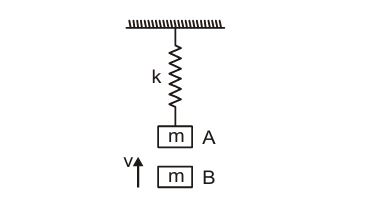
Block A is hanging from a vertical spring and is at rest. Block B strikes the block A with velocity v and sticks to it. Then the value of v for which the spring just attains natural length is :
4.
A particle of mass m is projected with an initial velocity v at an angle $\theta$ with the horizontal. What is work done by force of gravity from the instant of throw to the instant it reaches the highest point:
5.
Given below are two statements. One is labelled as Assertion (A) and the other is labelled as Reason (R).
Assertion (A): Newton's law of cooling say that the rate of cooling of a body is proportional to the excess temperature of the body over the surroundings.
Reason (R): $\frac{dQ}{dt}=-K(T_{2}-T_{1})^{2}$ Where $T_{1}$ is the temperature of surrounding medium and $T_{2}$ is the temperature of body.
Choose the correct answer from the options given below:
Assertion (A): Newton's law of cooling say that the rate of cooling of a body is proportional to the excess temperature of the body over the surroundings.
Reason (R): $\frac{dQ}{dt}=-K(T_{2}-T_{1})^{2}$ Where $T_{1}$ is the temperature of surrounding medium and $T_{2}$ is the temperature of body.
Choose the correct answer from the options given below:
6.
At what temperature is the root mean square speed of an atom in an argon gas cylinder equal to the rms speed of a helium gas atom at $-23^{\circ}C$? (atomic mass of Ar = 40 u, of He = 4.0 u)
7.
Two waves are represented by $y_{1}=a~\sin(\omega t+\frac{\pi}{3})$ and $y_{2}=a~\cos \omega t$ are superimposed. What will be their resultant amplitude:
8.
The speed of a swimmer is $4~km~h^{-1}$ in still water. If the swimmer makes his strokes normal to the flow of river of width 1 km, he reaches a point 750 m down the stream on the opposite bank. The speed of the river water is
9.
In a damped oscillation with damping constant b, the time taken for its mechanical energy to drop to half its value is
10.
The Vernier constant of Vernier callipers is 0.1 mm and it has zero error of -0.05 cm. While measuring diameter of a sphere, the main scale reading is 1.7 cm and coinciding vernier division is 5. The corrected diameter will be
11.
A ball rolls off the top of stair-way with a horizontal velocity of magnitude $1.8~ms^{-1}$. The steps are 0.20 m high and 0.20 m wide. Which step will the ball hit first?
12.
A conveyor belt is moving at constant speed of 4m/s. A box is gently dropped on it. The coefficient of friction between them is $\mu=0.5$. The distance that the box will move relative to belt before coming to rest on it, taking $g=10~m/s^{2}$, is:
13.
When a disc rotates with uniform angular velocity which of the following is not true:
14.
A force $\vec{F}=a\hat{i}+3\hat{j}+6\hat{k}$ is acting at a point $\vec{r}=2\hat{i}-6\hat{j}-12\hat{k}$. The value of a for which angular momentum about origin is conserved is:
15.
A disc of moment of inertia $0.4~kg-m^{2}$ and radius 0.2 m is free to rotate about a central axis. If a string is wrapped around it and it is pulled with a force of 10 N, then its angular velocity after 4 s will be:
16.
The height at which the weight of a body becomes (1/16)th of its weight on the surface of the earth of radius R, is:
17.
Imagine a new planet having the same density as that of earth but it is 2 times bigger than the earth in size. If the acceleration due to gravity on the surface of the new planet is g', then
18.
In thermodynamic processes which of the following statements is not true ?
19.
The density of a material in CGS system of units is $4~g/cm^{3}$. In a system of units in which unit of length is 10 cm and unit of mass is 100 g, the value of density of material will be :-
20.
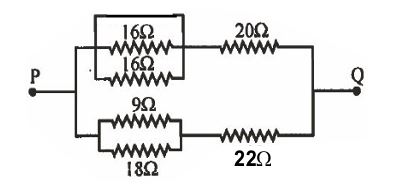
The equivalent resistance of the arrangement of resistances shown in adjoining figure between the points P and Q is:
21.
A good lubricant should have:
22.
Magnetic field in a plane EM wave is given by $B_{z}=2\times10^{-7}\sin(0.5\times10^{3}x-1.5\times10^{11}t)T$ then electric field is given by :
23.
The ratio of de-Broglie wavelength of molecules of hydrogen and helium in two jars kept separately at temperatures of $27^{\circ}C$ and $127^{\circ}C$ respectively is:
24.
The average emf induced in a coil when a current changes from 0 to 2A in 0.05 sec is 8V. The self-inductance of the coil is
25.
Due to the flow of current in a circular loop of radius R, the magnetic field produced at the centre of the loop is B. The magnetic moment of the loop is:
26.
A beam of ions enters normally into a uniform magnetic field of $4\times10^{-2}T$ with velocity $2\times10^{5}m/s$. If the specific charge of the ion is $5\times10^{7}C/kg$, then the radius of the circular path is
27.
If a cell of emf 12 V is connected with load of $5\Omega$ provides of current of 2 A, then internal resistance of the cell is
28.
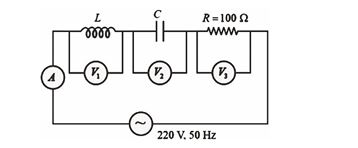
If the reading of voltmeter $V_{1}$ and $V_{2}$ in the given circuit diagram are 300 V each, then reading of voltmeter $V_{3}$ and ammeter A are, respectively
29.
Assertion: In YDSE, if $I_{1}=9I_{0}$ and $I_{2}=4I_{0}$ then $\frac{I_{max}}{I_{min}}=25.$
Reason: In YDSE, $I_{max}=\frac{1}{2}(\sqrt{I_{1}}+\sqrt{I_{2}})^{2}$ and $I_{min}=\frac{1}{2}(\sqrt{I_{1}}-\sqrt{I_{2}})^{2}.$
Reason: In YDSE, $I_{max}=\frac{1}{2}(\sqrt{I_{1}}+\sqrt{I_{2}})^{2}$ and $I_{min}=\frac{1}{2}(\sqrt{I_{1}}-\sqrt{I_{2}})^{2}.$
30.
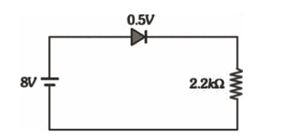
In the circuit, if the forward voltage drop for the diode is 0.5 V, the current will be
31.
The two ends P and N of a P-N diode junction are joined by a wire
32.
A ray of light incident normally on an isosceles right angled prism travels as shown in the figure. The least value of the refractive index of the prism must be

33.
Match List-I with List-II
List-I
(A) Biot-Savart's law
(B) Ampere's circuit law
(C) Force between two parallel current carrying conductors
(D) Lorentz force
List-II
(i) $\frac{\mu_{0}l_{1}l_{2}}{2\pi d}$
(ii) $q[\vec{E}+(\vec{V}\times\vec{B})]$
(iii) $\oint\vec{B}\cdot\vec{dl}=\mu_{0}\Sigma i$
(iv) $\vec{B}=\frac{\mu_{0}i}{4\pi}\int\frac{dl\sin\theta}{r^{2}}\hat{n}$
List-I
(A) Biot-Savart's law
(B) Ampere's circuit law
(C) Force between two parallel current carrying conductors
(D) Lorentz force
List-II
(i) $\frac{\mu_{0}l_{1}l_{2}}{2\pi d}$
(ii) $q[\vec{E}+(\vec{V}\times\vec{B})]$
(iii) $\oint\vec{B}\cdot\vec{dl}=\mu_{0}\Sigma i$
(iv) $\vec{B}=\frac{\mu_{0}i}{4\pi}\int\frac{dl\sin\theta}{r^{2}}\hat{n}$
34.
The two statements are given below.
Statement-I: When unpolarised light is incident on the polariser, the intensity of the transmitted polarised light remains unchanged.
Statement-II: Polarisation is convincing proof of transverse nature of light wave.
Statement-I: When unpolarised light is incident on the polariser, the intensity of the transmitted polarised light remains unchanged.
Statement-II: Polarisation is convincing proof of transverse nature of light wave.
35.
A ray of light falls on a transparent glass slab of refractive index 1.73. If the reflected ray and the refracted ray are mutually perpendicular, the angle of incidence is
36.
An $\alpha$-particle after passing through a potential difference of V volts collides with a nucleus. If the atomic number of the nucleus is Z, then the distance of closest approach of $\alpha$-particle to the nucleus will be
37.
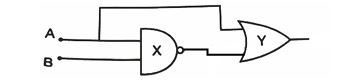
Identify the logic gates marked X and Y in the following figure.
38.
In the relation, $p=\frac{\alpha}{\beta}e^{\frac{-\alpha z}{K\theta}}$ where p is pressure, z is distance, K is Boltzmann constant and $\theta$ is temperature. The dimensional formula of $\beta$ will be
39.
Positive and negative charges of equal magnitude are kept at $A(0,0,\sqrt{a})$ and $B(0,0,-\sqrt{a})$ respectively. The work done by the electric field when another positive point charge is moved from (-2a, 0, 0) to (0, 2a, 0) is
40.
The work functions of three metals A, B and C are 1.92 eV, 2 eV and 5 eV, respectively. Which metals will emit photoelectrons for a radiation of wavelength 4100 $\mathring{A}$?
41.
Match List-I with List II.
List - I (Spectral Lines of Hydrogen for transitions from)
A. $n_{2}=3$ to $n_{1}=2$
B. $n_{2}=4$ to $n_{1}=2$
C. $n_{2}=5$ to $n_{1}=2$
D. $n_{2}=6$ to $n_{1}=2$
List - II (Wavelengths (nm))
I. 410.2
II. 434.1
III. 656.3
IV. 486.1
List - I (Spectral Lines of Hydrogen for transitions from)
A. $n_{2}=3$ to $n_{1}=2$
B. $n_{2}=4$ to $n_{1}=2$
C. $n_{2}=5$ to $n_{1}=2$
D. $n_{2}=6$ to $n_{1}=2$
List - II (Wavelengths (nm))
I. 410.2
II. 434.1
III. 656.3
IV. 486.1
42.
A solid conducting sphere having a charge Q is surrounded by an uncharged concentric conducting hollow spherical shell. Let the potential difference between the surface of solid sphere and that of the outer surface of hollow shell be V. What will be the new potential difference between the same two surfaces, if the shell is given a charge -3Q?
43.
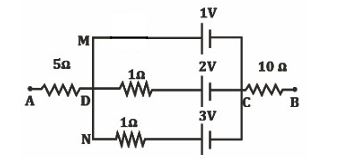
In the circuit, the potential difference between A and B is
44.
A capacitor stores $10\mu C$ charge when connected across a battery. When the gap between the plates is filled with a dielectric, a charge of $20\mu C$ flows through the battery. Find the dielectric constant of the dielectric.
45.
Match List-I with List-II
A. Magnetic induction $\rightarrow$ I. Ampere meter$^2$
B. Magnetic intensity $\rightarrow$ II. Weber
C. Magnetic flux $\rightarrow$ III. Gauss
D. Magnetic moment $\rightarrow$ IV. Ampere meter
Choose the correct answer from the options given below:
A. Magnetic induction $\rightarrow$ I. Ampere meter$^2$
B. Magnetic intensity $\rightarrow$ II. Weber
C. Magnetic flux $\rightarrow$ III. Gauss
D. Magnetic moment $\rightarrow$ IV. Ampere meter
Choose the correct answer from the options given below: