1.
A body of mass 2 kg initially at rest moves under the action of an applied horizontal force of 7 N on a table and work done against friction in 10 s. is 250 J then coefficient of kinetic friction is.
2.
A uniform chain is stable at a horizontal table and its $\frac{1}{n}$ part is on the table. The active friction coefficient between table and chain is:
3.
The escape speed of a projectile on the earth's surface is $11.2~km~s^{-1}$. A body is projected out with n times this speed. What is the speed of the body far away from the earth? Ignore the presence of the sun and other planets.
4.
Which of the following is correct:
5.
The potential energy of a body as a function of distance is given as $U(x)=(-6x^{2}+2x)$ J. The conservative force acting on body at $x=0$ m will be:
6.
Assertion: In uniform circular motion angular velocity of the particle is constant.
Reason: In uniform circular motion linear momentum of the particle is constant.
Reason: In uniform circular motion linear momentum of the particle is constant.
7.
What will be dimensions of A in the formula $A=\frac{me^{4}}{\epsilon_{0}^{2}h^{2}}$
8.
A projectile is thrown with an initial velocity of $\vec{V}=a\hat{i}+b\hat{j}$. If the range of the projectile is 4-times of the maximum height reached by it, then :
9.
A car is moving with a speed of $30~m/s$ on a circular path of radius 500 m. If its speed is increasing at a rate of $5~m/s^{2}$, then the magnitude of angular acceleration at that instant is:
10.
The radius of gyration of a solid sphere about a tangent is given by:
11.
A body attains a height equal to half of the radius of the earth. The kinetic energy of the body with which it was projected from the surface of earth:
12.
The radius (r), length (l) and resistance (R) of a metal wire was measured in the laboratory as :
$r=(0.35\pm0.05)~cm$
$R=(100\pm10)~ohm$
$l=(15\pm0.2)~cm$
The percentage error in resistivity of the material of the wire is:
$r=(0.35\pm0.05)~cm$
$R=(100\pm10)~ohm$
$l=(15\pm0.2)~cm$
The percentage error in resistivity of the material of the wire is:
13.
The volume of an ideal diatomic gas is doubled isobarically. The internal energy :
14.
The excess pressure inside a spherical drop of water is four times that of another drop. Then their respective mass ratio is:
15.
Assertion: The isothermal curves never intersect each other at a certain point.
Reason: The adiabatic changes may occur slowly.
Reason: The adiabatic changes may occur slowly.
16.
An organ pipe $P_{1}$ closed at one end vibrating in its first overtone and another pipe $P_{2}$ open at both ends vibrating in its second overtone are in resonance with a given tuning fork. The ratio of the length of $P_{1}$ to that of $P_{2}$ is
17.
The reciprocal of bulk modulus is called:
18.
Find the angular frequency of particle from given equation: $\frac{4d^{2}y}{dt^{2}}+9y=4$ (Where y = displacement and t = time)
19.
A faulty thermometer has its fixed points marked as -5 and 95. If the temperature of a body as shown on celsius scale is $65^{\circ}C$, then it's temperature shown on this faulty Thermometer is:
20.
The ratio $C_{P}/C_{V}$ for helium is $5/3$ and that for hydrogen is 7/5. The ratio of velocity of sound in helium to that in hydrogen at the same temperature and pressure is:
21.
A particle is executing simple harmonic motion (S.H.M.). The ratio of potential energy and total energy of the particle when its displacement is half of its amplitude will be:
22.
Assertion (A): Susceptibility is defined as the ratio of intensity of magnetisation (M) to magnetic intensity (H).
Reason (R): Greater the value of susceptibility smaller value of intensity magnetisation.
Reason (R): Greater the value of susceptibility smaller value of intensity magnetisation.
23.
Magnetic field at the centre of regular polygon of 'n' sides which is formed by a constant length wire, which carries current I and side of polygon is 'a':
24.
Which of the following statements are correct:
(I) The wavelength of microwave is greater then that of UV-rays.
(II) The wavelength infrared rays is lesser than that of UV-rays
(III) The wavelength of microwave is lesser than that of infrared rays.
(IV) Gamma rays have shortest wavelengths in the electromagnetic spectrum
(I) The wavelength of microwave is greater then that of UV-rays.
(II) The wavelength infrared rays is lesser than that of UV-rays
(III) The wavelength of microwave is lesser than that of infrared rays.
(IV) Gamma rays have shortest wavelengths in the electromagnetic spectrum
25.
Assertion (A): Resonance phenomenon can exhibit by a circuit only if both L and C are present in the circuit.
Reason (R): Voltage across L and C cancel each other and the current amplitude is $\frac{V_{m}}{R}$ the total source voltage appearing across R causes resonance.
Reason (R): Voltage across L and C cancel each other and the current amplitude is $\frac{V_{m}}{R}$ the total source voltage appearing across R causes resonance.
26.
Two resistance $400\Omega$ and $800\Omega$ are connected in series with 6 V battery. The potential difference measured by voltmeter of $10k\Omega$ across $400\Omega$ resistor is:
27.
The resultant capacitance of given circuit is :
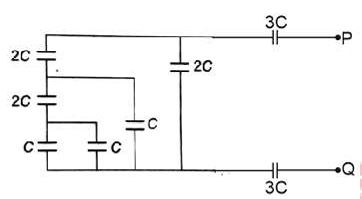
28.
A storage battery of emf 8 V and internal resistance $0.5\Omega$ is being charged by a 120 V DC supply using a series resistor of $15.5\Omega$. What is the terminal voltage of the battery during charging :
29.
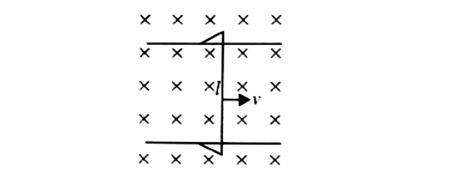
The figure shows a wire sliding on two parallel conducting rails placed at a separation l. A magnetic field B exists in a direction perpendicular to the plane of the rails. The force required to kept the wire moving at a constant velocity v will be:
30.
Magnetic energy stored in solenoid is given by:
31.
A 1m long metallic rod is rotated with an angular frequency of 200 rad/s about an axis normal to the rod passing through its one end. The other end of rod is in contact with a circular metallic ring. A constant & uniform magnetic field of 0.5 T parallel to axis exists everywhere. Find emf developed between the centre & ring:
32.
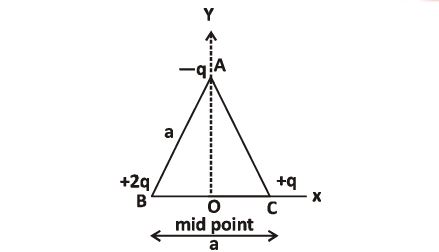
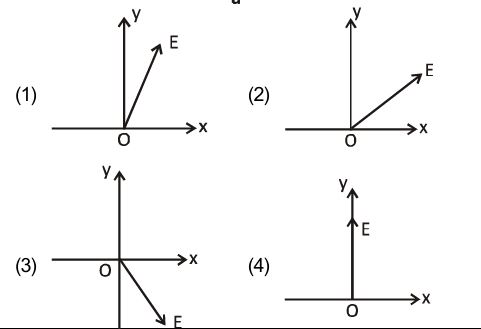
In the given diagram there is an equilateral triangle of side a & charge -q, + 2q & + q are placed at vertex A, B & C respectively. The resultant electric field direction at mid point O is:
33.
24 J of work to be done against an existing electric field to take a charge of 0.01 C from A to B. Find the potential difference $V_{B}-V_{A}$.
34.
The electric field of an electromagnetic wave in free space is represented as $\vec{E}=E_{0}\cos(\omega t-kz)\hat{i}$. The corresponding magnetic induction vector will be:
35.
If particles are moving with same velocity, the maximum de-Broglie wavelength will be for:
36.
Two energy levels of an electron in an atom are separated by 3.3 eV. The frequency of radiation emitted when the electrons goes from higher to the lower level is:
37.
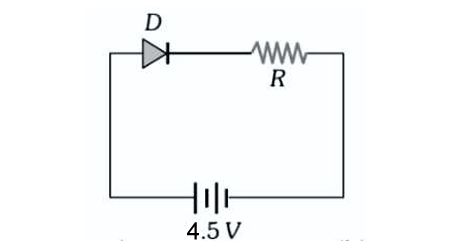
In the given figure a diode D is connected to an external resistance $R=200\Omega$ and an e.m.f of 4.5 V. If the barrier potential developed across the diode is 0.5 V, the current in the circuit will be:
38.
Identify the true statement of OR gate:
39.
Although carbon, silicon and germanium have same lattice structure and four valence electrons each, their band structure leads to the energy gaps as:
40.
In a double slit experiment, when light of wavelength 400 nm was used, the angular width of the first minima formed on a screen placed 1 m away, was found to be $0.4^{\circ}$. What will be the angular width of the first minima, if the entire experimental apparatus is immersed in water ? $(\mu_{water}=4/3)$
41.
A nucleus with mass number 240 breaks into two fragments each of mass number 120, the binding energy per nucleon of unfragmented nuclei is 9 MeV while that of fragments is 10 MeV. The total gain in the Binding Energy in the process is :
42.
The surface of a metal is illuminated with the light of 500 nm. The kinetic energy of the ejected photoelectrons was found to be 0.8 eV. The work function of the metal is: $[hc=1240~eV-nm]$
43.
The minimum angle of deviation is $30^{\circ}$ by a hollow prism filled with liquid. Ray of light refracted at an angle $30^{\circ}$ at the first surface. If refractive index of liquid is n. Then find $n^{2}$:
44.
In a Young's double-slit experiment the fringe width is 0.24 mm. If the wavelength of light used is increased by 10% and the separation between the slits is also increased by 10%, the fringe width will be:
45.
If the distance between object and its two times magnified virtual image produced by a curved mirror is 15 cm, the focal length of the mirror must be: