1.
A particle of mass m is projected with an initial velocity v at an angle $\theta$ with the horizontal. What is work done by force of gravity from the instant of throw to the instant it reaches the highet point:
2.
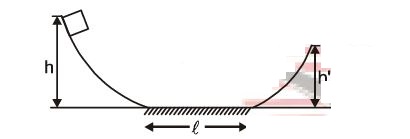
A block is released from rest from height $h=5m$. After travelling through curved surface it moves on the rough horizontal surface through a length $l=8$ m and climbs on to the other smooth curved surface through a height $h^{\prime}$ If $\mu=0.5$ Find h':
3.
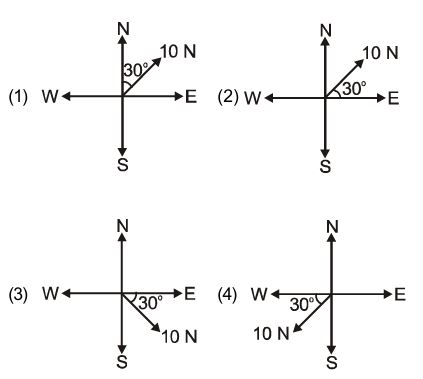
Which of the following figures represents the force of 10 N in a direction of $30^{\circ}$ east of north :
4.
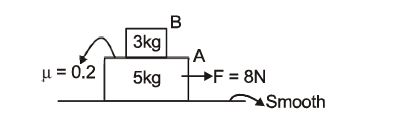
A block of mass 3 kg is placed on another block of mass 5kg. If friction coefficient between both blocks is 0.2, while there is no friction between 5 kg block and ground. A force of 8N applied to lower block so that both blocks move together, then friction force on the block 3kg is:
5.
Particle P is revolved such that it sweeps out length $s=t^{3}+5$. Find acceleration of P at $t=2$ sec:

6.
Two perfectly elastic particles A and B of equal masses traveling along the line joining them with velocity $15~m/s$ and $10~m/s$ respectively, collide. Their velocities after the perfectly elastic collision will be (in m/s), respectively:
7.
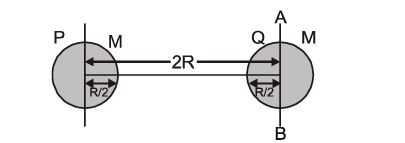
Two spheres each of mass M and radius $R/2$ are conected with a massless rod of length 2R as shown in the figure: The moment of inertia of the system about an axis AB passing through the centre of one of the spheres and perpendicular to the rod is :
8.
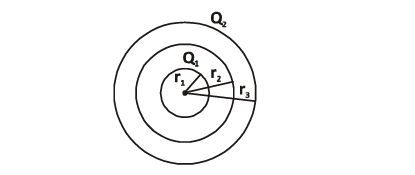
Figure shows three concentric metallic spherical shells. The outermost shell has charges $Q_{2}$ the innermost shell has charge $Q_{1}$ & the middle shell is uncharged. The charge density on the inner surface of outermost shell is:
9.
If charges q, Q and 3q are at distance a and 2a respectively. Nature and value of Q for which 'q' will be in equilibrium :

10.
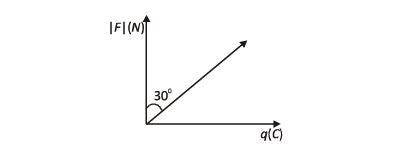
In an electric field force on different test charge varies as shown in graph. The magnitude of electric field is:
11.
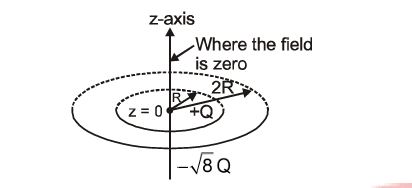
Two concentric rings, one of radius R and total charge +Q and the second of radius 2R and total $-\sqrt{8}Q$, lie in x-y plane (i.e., $z=0$ plane). The common centre of rings lies at origin and the common axis coincides with z-axis. The charge is uniformly distributed on both rings. At what distance from origin is the net electric field on z-axis zero :
12.
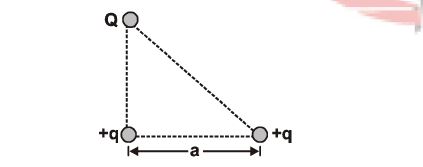
Three charges Q, +q and +q are placed at the vertices of a right-angled isosceles triangle as shown. The net electrostatic energy of configuration is zero if Q is equal to:
13.
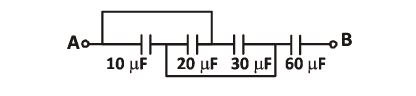
Find the equivalent capacitance between A & B :
14.
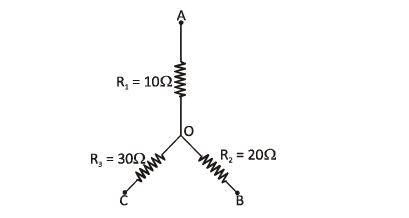
In the circuit shown $R_{1}=10$ ohm, $R_{2}=20$ ohm, $R_{3}=30$ ohm and the potentials of points A, B and C are 30 V, 12V and 2V respectively. The current though resistance $R_{1}$ is:
15.
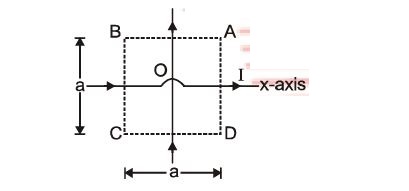
Two infinite length wires carries equal current and placed along x and y axis respectiely. At which points the resultant magnetic field is zero :
16.
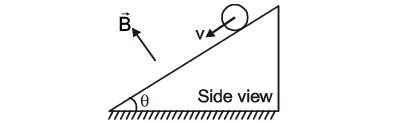
A conducting rod of length l and mass m is moving down a smooth inclined plane of inclination $\theta$ with a constant velocity v. A current 'i' is flowing in the conductor in a direction perpendicular to paper inwards. A magnetic field perpendicualr to incline plane B exists in space. Then magnitude of magnetic field B is:
17.
The electric field associated with an e.m. wave in vacuum is given by $\vec{E}=\hat{i}40~\cos(kz-6\times10^{8}t)$, where E, z and t are in volt/m, meter and seconds respectively. The value of wave vector k is:
18.
Current i flows through a long wire. A square loop made of conducting wire held below the wire in the same vertical plane is released and allowed to fall under gravity. If acceleration of the loop is a, then:

19.
A monoatomic ideal gas, intially at temperature $T_{1}$ is enclosed in a cylinder fitted with a frictionless piston. the gas is allowed to expand to a temperature $T_{2}$ by releasing the piston suddenly. If $L_{1}$ and $L_{2}$ be the lengths of the gas column before and after the expansion respectively, then $\frac{T_{1}}{T_{2}}$ given by:
20.
The first law of thermodynamics is based on:
21.
The amount of heat energy required to raise the temperature of 1 g of helium gas from $T_1 K$ to $T_2 K$ is:
22.
If the amplitude of sound is doubled and the frequency reduced to one-fourth, the intensity will:
23.
If the amplitued of damed oscillator becomes $1/3^{rd}$ in 2 sec. If after 6 sec its amplitued becomes $1/n^{th}$ of original than n is:
24.
When a guitar string is sounded with a 440 Hz tuning fork, a beat frequency of 5 Hz is heard. If the experiment is repeated with a tuning fork of 437 Hz, the beat frequency is 8 Hz. The string freqeuency (Hz) is:
25.
The diameter of rain-drop is 0.02 cm. If surface tension of water be $72\times10^{-3}$ newton per metre, then the pressure difference of external and internal surfaces of the drop will be :
26.
The maximum velocity of an electron emitted by light of wavelength $\lambda$ incident on the surface of a metal of work function $\phi$ is:
27.
In a pure silicon $(n_{i}=10^{16}/m^{3})$ crystal at 300 K, $10^{21}$ atoms of phosphorus are added per cubic meter. The new hole concentration will be :
28.
The power obtained in a reactor using U235 disintegration is 1000 kW. The mass decay of U235 per hour is:
29.
Current through the ideal diode is :
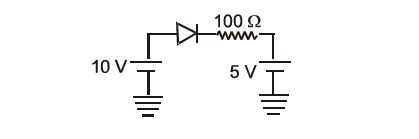
30.
For a parallel beam of light, wavefront is:
31.
The core of a transformer is laminated because :
32.
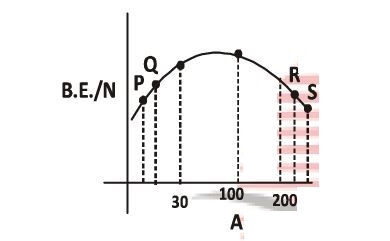
If graph between binding energy per nuclion with mass no. A is shown in figure there are 4 elements P, Q, R, S, shown on the graph then select the correct option:
33.
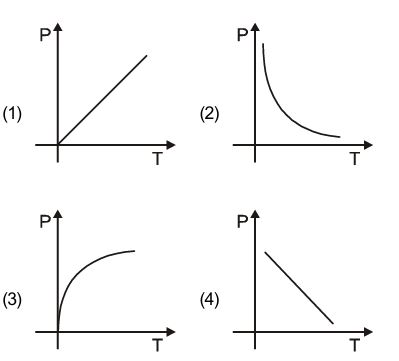
A soap bubble is blown slowly at the end of a tabe by a pump supplying air at constant rate. Which one of the following graph represents the correct variation of the excess pressure inside the bubble with time (temperature is constant):
34.
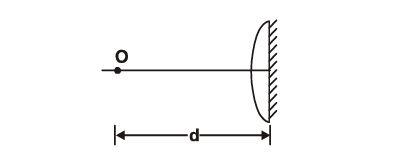
A plano convex lens of focal length $f=10$ cm and $\mu=\frac{3}{2}$ is silvered at its plane face. The distance d at which an object O must be placed in order to get its image an it self is:
35.
Due to air, a falling body faces a resistive force proportional to square of velocity, consequently its effective downwards acceleration is reduced and is given by $a=g-kv^{2},$ where $k=0.002~m^{-1}.$ The terminal velocity of the the falling body is:
36.
The magnetic flux through a circuit of resistance R changes by an amount $\Delta\phi$ in a time $\Delta t.$ Then the total quantity of electric chagre Q that passes any point in the circuit during the time $\Delta t$ is :
37.
Match the events in column-I with the correct results in column-II.
Column-I (Event)
A. Maximum speed of a car on a circular horizontal road without skidding.
B. Minimum stopping distance of a vehicle of mass m moving with momentum p when brakes are applied (coefficient of friction $\mu$).
C. A body slides down a $45^{\circ}$ rough incline in twice the time taken on the same smooth incline.
D. Velocity of a block at the bottom of an incline of length L and angle $\theta$ with Friction coefficient $\mu$.
Column-II (Result)
1. $\mu=0.75$
2. $v_{max}=\sqrt{\mu Rg}$
3. $S_{min}=\frac{P^{2}}{2\mu m^{2}g}$
4. $v=\sqrt{2gL(\sin~\theta-\mu~\cos~\theta)}$
Column-I (Event)
A. Maximum speed of a car on a circular horizontal road without skidding.
B. Minimum stopping distance of a vehicle of mass m moving with momentum p when brakes are applied (coefficient of friction $\mu$).
C. A body slides down a $45^{\circ}$ rough incline in twice the time taken on the same smooth incline.
D. Velocity of a block at the bottom of an incline of length L and angle $\theta$ with Friction coefficient $\mu$.
Column-II (Result)
1. $\mu=0.75$
2. $v_{max}=\sqrt{\mu Rg}$
3. $S_{min}=\frac{P^{2}}{2\mu m^{2}g}$
4. $v=\sqrt{2gL(\sin~\theta-\mu~\cos~\theta)}$
38.
Assertion A: Some Balmer spectral lines may lie in ultraviolet region.
Reason R: For Balmer series $\frac{1}{\lambda}=R(\frac{1}{2^{2}}-\frac{1}{n^{2}}),$ $n=3,4,5,....$
Reason R: For Balmer series $\frac{1}{\lambda}=R(\frac{1}{2^{2}}-\frac{1}{n^{2}}),$ $n=3,4,5,....$
39.
The image of a small electric bulb fixed on a wall of a room is to be obtained on the opposite wall 3 m away by means of a large convex lens. What is the maximum possible focal length of the lens required for this purpose?
40.
Which one of the following statements regarding AC circuits is correct?
41.
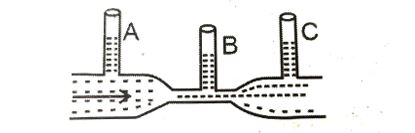
Three tubes A, B and C are connected to a horizontal pipe through which an ideal fluid is flowing. The radii of the pipe at A, B and C are 2 cm, 1 cm and 2 cm respectively. Which of the following conclusions is correct?
42.
A particle of mass 4 kg performs simple harmonic motion S.H.M. in a straight line under the force $F=(15-3x)N.$ The particle is released from rest at $x=7m$. The amplitude of S.H.M. is:
43.
Young's modulus :
44.
Two particles of masses 2 kg and 6 kg located at the paoint (1 m, 1 m, 1 m) and (2 m, 2 m, 1 m) respectively. The distance of centre of mass from 2 kg mass will be:
45.
If the temperature of gas is doubled keeping volume constant. We know from the gas law that the pressure will be doubled. On microscopic level this incrase in pressure occurs because.