PHYSICS BYTES
Rank Booster Test Series - 01
TOPIC : Unit, Dimension and Errors, Vector, Motion in Straight Line, Motion in a Plane | Experimental Skills - Vernier callipers, Screw Gauge
BEWARE OF NEGATIVE MARKING
1.
A motorboat is racing towards north at 25 km/h and the water current in that region is 10 km/h in the direction of $60^{\circ}$ east of south. Find the resultant velocity of the boat.
2.
A vector $\vec{a}$ is turned without a change in its length through a small angle $d\theta$. The value of $|\Delta\vec{a}|$ and $\Delta|\vec{a}|$ are respectively:
3.
Which one of the following is not a derived unit:
4.
The dimensional formula of physical quantity is $[M^{a}L^{b}T^{c}]$. Then that physical quantity is:
5.
Drop of water fall from the roof of a building which is 18m high at regular intervals of time. When the first drop reaches the ground, at the same instant fourth drop begins to fall. What are the distances of the second and third drops from the roof:
6.
Which of the following is not correct
7.
The magnitude of the vector product of two vectors $\vec{A}$ and $\vec{B}$ may be :
(a) Greater than AB
(b) Equal to AB
(c) Less than AB
(d) Equal to zero
(a) Greater than AB
(b) Equal to AB
(c) Less than AB
(d) Equal to zero
8.
18 different co-planar vectors (all are equal magnitude) maintain a system in equilibrium, then the angle between two adjacent vectors is:
9.
Given, $\vec{a}+\vec{b}+\vec{c}+\vec{d}=0$, which of the following statement is correct:
(a) $\vec{a}, \vec{b}, \vec{c}$ and $\vec{d}$ must each be a null vector
(b) The magnitude of $(\vec{a}+\vec{c})$ equals the magnitude of $(\vec{b}+\vec{d})$
(c) The magnitude of $\vec{a}$ can never be greater than the sum of magnitude of $\vec{b}, \vec{c}$ and $\vec{d}$.
(d) $\vec{b}+\vec{c}$ must lie in the plane of $\vec{a}$ and $\vec{d}$.
(a) $\vec{a}, \vec{b}, \vec{c}$ and $\vec{d}$ must each be a null vector
(b) The magnitude of $(\vec{a}+\vec{c})$ equals the magnitude of $(\vec{b}+\vec{d})$
(c) The magnitude of $\vec{a}$ can never be greater than the sum of magnitude of $\vec{b}, \vec{c}$ and $\vec{d}$.
(d) $\vec{b}+\vec{c}$ must lie in the plane of $\vec{a}$ and $\vec{d}$.
10.
A wire of length $l=12\pm0.06$ cm and radius $r=1\pm0.005$ cm and mass $m=0.3\pm0.003$ gm. Maximum percentage error in density is :
11.
If E, M, J and G are respectively energy, mass, angular momentum and gravitational constant, then the dimensions of $M^{6}G^{2}/EJ^{2}$ are equivalent to the dimensions of:
12.
The square root of the product of inductance and capacitance has the dimensions of:
13.
If force (f), acceleration due to gravity (g) and pressure (p) are taken as the fundamental units, what will be the dimensional formula for mass in this system of units :
14.
If R and L represent, respectively resistance and self-inductance, which of the following combinations has the dimensions of frequency:
15.
A body thrown vertically upwards direction it passes from same height at 4 sec and 6 sec respectively. Then find initial velocity of body ($g=10~m/s^{2}$)
16.
A body is thrown horizontally from the top of a tower and strikes the ground after 3 sec, at an angle of $45^{\circ}$ with the horizontal. The height of the tower will be:
17.
Measurement of a physical quantity is essentially
18.
If the unit of force is 1 kilonewton, the length is 1 km and time 100 s, what will be the unit of mass?
19.
If y denotes the displacement and t denotes the time and the displacement is given by $y = a\sin\omega t$, the velocity of the particle is
20.
A particle is moving such that its position coordinates (x, y) are (2 m, 3 m) at time $t=0$, (6 m, 7 m) at time $t=2s$, and (13 m, 14 m) at time $t=5s$. Average velocity vector ($\vec{v}_{av}$) from $t=0$ to $t=5s$ is
21.
Component of acceleration which changes the speed.
22.
The speed of a projectile when it is at its greatest height is $\sqrt{\frac{2}{5}}$ times its speed at half the maximum height. What is the angle of projection?
23.
Ram and Shyam are at A and B as shown in figure and simultaneously starts moving with $a\hat{i}$ and $b\hat{j}$ along and perpendicular to line AB, then
(a) They will meet after time $t=\frac{L}{\sqrt{a^{2}+b^{2}}}$
(b) They can not meet each other
(c) They will be closest at $t=\frac{La}{a^{2}+b^{2}}$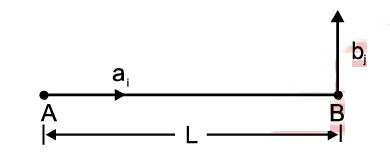
(a) They will meet after time $t=\frac{L}{\sqrt{a^{2}+b^{2}}}$
(b) They can not meet each other
(c) They will be closest at $t=\frac{La}{a^{2}+b^{2}}$
24.
Given below are two statements: one is labelled as Assertion (A) and the other is labelled as Reason (R).
Assertion (A): In projectile motion, the angle between the instantaneous velocity and acceleration at the highest point is $180^{\circ}$.
Reason (R): At the highest point, velocity of projectile will be in horizontal direction only.
Assertion (A): In projectile motion, the angle between the instantaneous velocity and acceleration at the highest point is $180^{\circ}$.
Reason (R): At the highest point, velocity of projectile will be in horizontal direction only.
25.
The ratio of magnitudes of angular velocity of the hour hand of a watch to that of earth's rotation about its own axis is :
26.
A body travels, with uniform acceleration $a_{1}$ for time $t_{1}$ and with uniform acceleration $a_{2}$ for time $t_{2}$. What is the average acceleration?
27.
Which are of the following represents uniformly accelerated motion :
28.
Two bodies begin to fall freely from the same height but the second falls T second after the first. The time (after which the first body begins to fall) when the distance between the bodies equals L is
29.
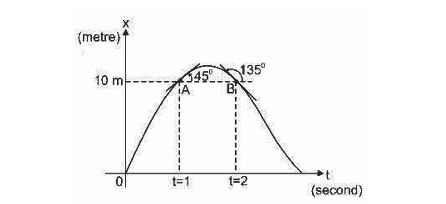
Displacement-time curve of a particle moving along a straight line is shown in figure. Tangents at A and B make angles $45^{\circ}$ and $135^{\circ}$ with positive x-axis respectively. The average acceleration of the particle during $t=1$ to $t=2s$
30.
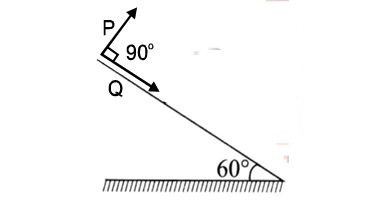
A particle P is projected from a point on the surface of long smooth inclined plane and Q starts moving down the plane from the same position. P and Q collide after 4 second. The speed of projection of P is: ($g=10~m/s^{2}$)
31.
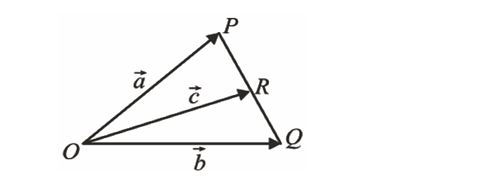
Figure shows three vectors $\vec{a}, \vec{b}$ and $\vec{c}$, where R is the midpoint of PQ. Then which of the following relations is correct:
32.
Square of the resultant of two forces of equal magnitude is equal to three times the product of their magnitude. The angle between them is:
33.
$\vec{A}+\vec{B}=\vec{C}$, the angle between $\vec{A}$ and $\vec{B}$ is $120^{\circ}$ and $A=B$. Then what is the angle between $\vec{A}$ and $\vec{C}$:
34.
If $\vec{C}=\vec{A}+\vec{B}$, then $(\frac{C}{A})^{2}>[1+(\frac{B}{A})^{2}]$ is true for angle between $\vec{A}$ and $\vec{B}$ :
35.
A student when discussing the properties of a medium (except vacuum) writes Velocity of light in vacuum = velocity of light in medium. The formula is
36.
A particle is moving along x-axis whose instantaneous speed is $V^{2}=108-9x^{2}$. The acceleration of particle is
37.
Two paper screens A and B are separated by distance 100 m. A bullet penetrates A and B, at points P and Q respectively, where Q is 10 cm below P. If bullet is travelling horizontally at the time of hitting A, the velocity of bullet at A is nearly:
38.
A body is thrown vertically upwards and takes 5 seconds to reach maximum height. The distance travelled by the body will be same in:
39.
If x and x' are the coordinates of a particle in two frames of reference S and S' moving with respect to each other with a velocity v along the x-axis and having the coordinates axes parallel to each other, then which of the following is correct relation:
40.
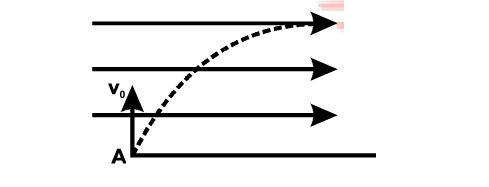
A particle is projected in vertical upward direction with velocity $v_{0}$ but due to horizontal wind blowing towards right the particle experiences a horizontal acceleration of $a~m/s^{2}$ (constant). The horizontal distance travelled by particle in a time interval in which its velocity vector rotated by $90^{\circ}$ is:
41.
A stone dropped from the top of a tower of height h. After 1 second another stone is dropped from the balcony 20 m below the top. Both reach the bottom simultaneously. What is the value of h?
42.
The acceleration of a body falling from rest in a resisting medium is described by the equation $a=\alpha-\beta v$ where $\alpha$ and $\beta$ are constant, the velocity at any time t is:
43.
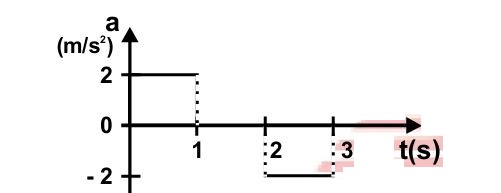
Acceleration-time graph for a particle is given in figure. If it starts motion at $t=0$, distance travelled in 3s will be:
44.
A rocket is fired vertically from the ground. Its moves upwards with a constant acceleration $10~m/s^{2}$ after 30 sec the fuel is finished. After what time from the instant of firing the rocket will attain the maximum height? $g=10~m/s^{2}$:
45.
A stone falls from a balloon that is descending at a uniform rate of $12~m/s$. The displacement of the stone from the point of release after 10 sec is: take ($g=9.8m/s^{2}$)