PHYSICS BYTES
Rank Booster Test Series - 02
TOPIC : Unit, Dimension and Errors, Vector, Motion in Straight Line, Motion in a Plane | Experimental Skills - Vernier callipers, Screw Gauge
BEWARE OF NEGATIVE MARKING
1.
A body moving at $2~m/s$ can be stopped over a distance x. If its kinetic energy is doubled, how long will it go befoe coming to rest, if the retarding force remains unchanged?
2.
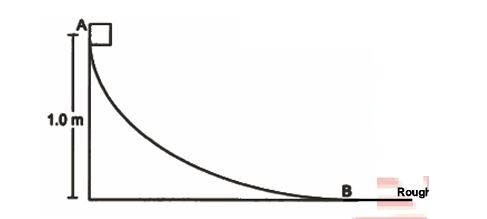
A block weighing 10 N travels down a smooth curved track AB joined to a rough horizontal surface (figure). The rough surface has a friction coefficient of 0.20 with the block. If the block starts slipping on the track from a point 1.0 m above the horizontal surface, the distance it will move on the rough surface is :
3.
The kinetic energy of a particle continuously increases with time. In this situation which of the following statement is correct?
4.
The work done on a particle of mass m by a force, $K[\frac{x}{(x^{2}+y^{2})^{3/2}}\hat{i}+\frac{y}{(x^{2}+y^{2})^{3/2}}\hat{j}]$ (K being a constant a appropriate dimensions), when the particle is taken from the point (a, 0) to the point (0, a) along a circular path of radius a about the origin in the x-y plane is:
5.
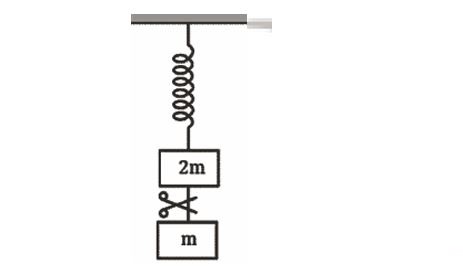
System shown in figure is in equilibrium and at rest. The spring and string are massless. Now the string is cut. The acceleration of mass 2m and m just after the string is cut will be :
6.
A block starts moving up an inclined plane of inclination $30^{\circ}$ with an initial velocity of $v_{0}$. It comes back to its initial position with velocity $\frac{v_{0}}{2}$. The value of the coefficient of kinetic friction between the block and the inclined plane is close to $\frac{I}{1000}$. The nearest integer to I is:
7.
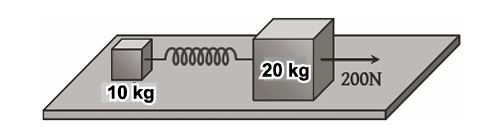
Two blocks of masses 10 kg and 20 kg are connected by a light spring as shown. A force of 200 N acts on the 20 kg mass as shown. At a certain instant the acceleration of 10 kg mass is $12~ms^{-2}$ towards right direction.
8.
Consider the following statement:
Statement I: The work energy theorem is indipendent of Newton's second law
Statement II: Every force encountered in mechantcs does not have an assoclated potential energy.
Statement I: The work energy theorem is indipendent of Newton's second law
Statement II: Every force encountered in mechantcs does not have an assoclated potential energy.
9.
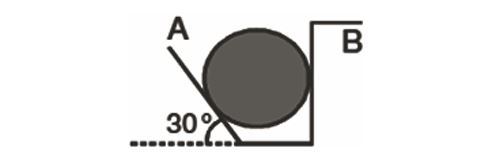
The 50 kg homogeneous smooth sphere rests on the $30^{\circ}$ incline A and bears against the smooth vertical wall B. Calculate the contact forces at A and B.
10.
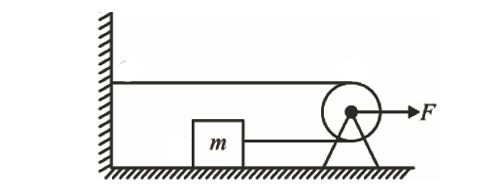
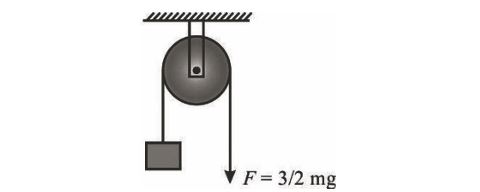
In the given figure the pulley is assumed massless and frictionless. If the friction force on the object of mass m is f, then its acceleration in terms of the force F will be equal to
11.
The force required to just move a body up an inclined plane is double the force required to just prevent it from sliding down. If $\phi$ is the angle of friction and $\theta$ is the angle which the plane makes with horizontal, then
12.
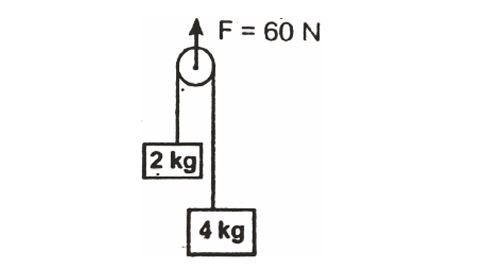
The magnitude of acceleration of blocks of mass 2 kg and 4 kg are respectively (Pulleys and threads are massless) $(g=10~m/s^{2})$
13.
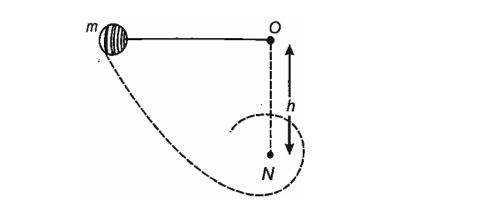
A particle of mass m attached to the end of string of length l is released from the horizontal position. The particle rotates in a circle about O as shown. When it is vertically below O, the string makes contact with a nail N placed directly below O at a distance h and rotates around it. For the particle to swing completely around the nail in a circle.
14.
A block slips with constant velocity on a plane inclined at an angle $\theta$. The same block is pushed up the plane with an initial velocity v. The distance covered by the block before coming to rest is:
15.
In the arrangement shown, the mass m will ascend with an acceleration (Pulley and rope are massless)
16.
A pulley is attached to the ceiling of a lift moving upwards. Two particle are attached to the two ends of a string passing over the pulley. The masses of the particles are in the ratio 2: 1. If the acceleration of the particle is $g/2$ (with respect to lift), then the acceleration of the lift will be :
17.
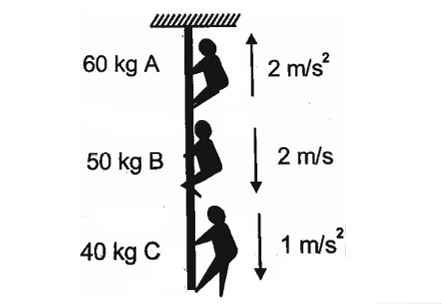
Tension in rope at rigid support is:
18.
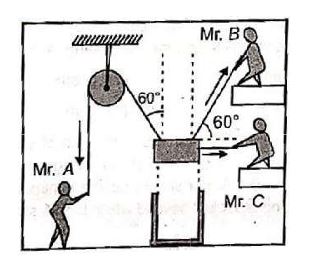
Mr. A, B and C are trying to put a heavy piston into a cylinder at a mechanical workshop in railway yard. If they apply forces $F_{1}$, $F_{2}$ and $F_{3}$ respectively on ropes then for which set of forces at that instant, they will be able to perform the said job?
19.
From Newton's second law of motion, it can be inferred that:
20.
In accordance with Newton's third law of motion:
21.
A heavy uniform chain lies on horizontal table top. If the coefficient of friction between the chain and the table surface is 0.25, then the maximum fraction of the length of the chain that can hang over one edge of the table is:
22.
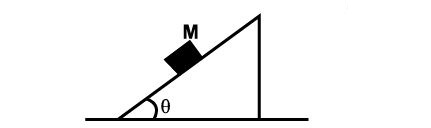
A mass M is placed on a very smooth wedge resting on a surface without friction. Once the mass is released, the acceleration to be given to the wedge so that M remains at rest on it.
23.
Which of the statements are false:
24.
A body with mass 5 kg is acted upon by a force $\vec{F}=(-3\hat{i}+4\hat{j})N.$ If its initial velocity at $t=0$ is $\vec{u}=(6\hat{i}-12\hat{j})ms^{-1}$ the time at which it will just have a velocity along y-axis is
25.
If a body placed at the origin is acted upon by a force $\vec{F}=(\hat{i}+\hat{j}+\sqrt{2}\hat{k}),$ then which of the following statements are correct.
(A) Magnitude of F is $(2+\sqrt{2})$
(B) Magnitude of F is 2
(C) F makes an angle of $45^{\circ}$ with the Z-axis
(D) F makes an angle of $30^{\circ}$ with the Z-axis
Select the correct answer using the codes given below.
(A) Magnitude of F is $(2+\sqrt{2})$
(B) Magnitude of F is 2
(C) F makes an angle of $45^{\circ}$ with the Z-axis
(D) F makes an angle of $30^{\circ}$ with the Z-axis
Select the correct answer using the codes given below.
26.
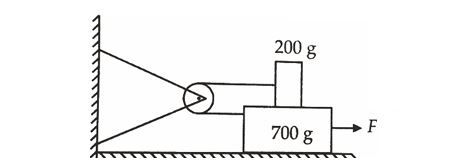
How large must F be in the figure shown to give the 700 g block an acceleration of $30~cm/s^{2}?$ The coefficient of friction between all surfaces is 0.15.
27.
At time (t) seconds a particle of mass 3 kg has position vector (r) metres where $\vec{r}=3t\hat{i}-4~cost\hat{j}$ find impulse (e) to the force during time interval $0 \le t \le \pi/2$.
28.
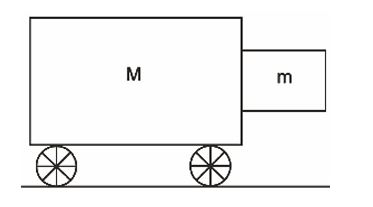
A cart of mass M has a block of mass m attached to it as shown in figure. The coefficient of friction between the block and the cart is $\mu$. What is the minimum acceleration of the cart so that the block m does not fall:
29.
The blades of a windmill sweep out a circle of area A. If the wind (density $\rho$) flows at a velocity v perpendicular to the circle. What is the mass of the air passing through it in time t?
30.
The motion of a particle of mass m is given by $x=0$ for $t < 0$ s, $x(t)=A~sin~4\pi t$ for $0 < t < (1/4)$ s $(A > 0)$, and $x=0$ for $t > (1/4)$ s. Which of the following statements is true?
31.
A man squatting on the ground gets straight up and stand. The force of reaction of ground on the man during the process is
32.
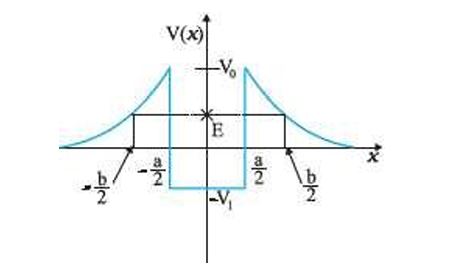
In the given figure potential energy functions in one dimension is ploted with position x. The total energy of the particle is indicated by a cross on the ordinate axis then which of the following is wrong.
33.
A bullet of mass 0.01 kg and moving with a velocity of $500~m/s$ strikes a block of mass 2 kg suspended from a 5 meter long string. The centre of gravity of the block rises vertically upwards through a height of 0.1 meter. The velocity of the bullet after emerging out of the block will be
34.
A small block of mass m is kept on a rough inclined surface of inclination $\theta$ fixed in an elevator. The elevator goes up with a uniform velocity v an block does not slide on the wedge. The work done by force of friction block in time t will be:
35.
A uniform chain of mass M and length L is held on a horizontal frictionless table with $(1/n)th$ of its length hanging over the edge of the table. The work done in pulling the chain up on the table is
36.
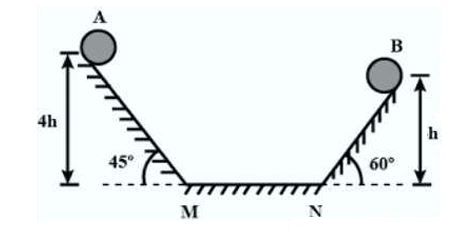
Two identical balls A and B are released from the positions shown in figure. They collide elastically on horizontal portion MN. The ratio of the heights attained by A and B after collision will be (neglect friction):
37.
A juggler throws balls continuously at the rate of three in each second each with a velocity of $10~ms^{-1}$. If the mass of each ball is 0.05 kg his power is
38.
Which of the following statements are correct:
39.
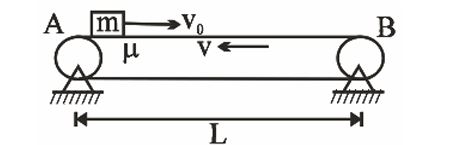
With what minimum velocity $v_{0}$ (w.r.t. belt) should block be projected from left end A towards end B such that it reaches the other end B of conveyer belt moving with constant velocity v? Friction coefficient between block and belt is $\mu$.
40.
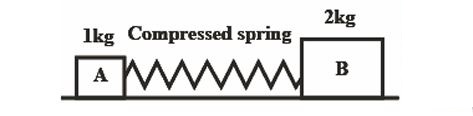
An elastic spring is compressed between two blocks of masses 1 kg and 2 kg resting on a smooth horizontal table as shown. If the spring has 12 J of energy and suddenly released, the velocity with which the larger block of 2 kg moves will be when spring is in natural length
41.
A tank on the roof of a 20 m high building can hold $10~m^{3}$ of water. The tank is to be filled from a pond on the ground in 20 minutes. If the pump has an efficiency of 60%, the input power required is
42.
Match the column I to column II :
Column I
A. Newton's First law
B. Newton's second law
C. Newton's third law
D. Linear Momentum
A. Newton's First law
B. Newton's second law
C. Newton's third law
D. Linear Momentum
Column II
P. $\vec{F}=m\vec{a}$
Q. law of inertia
R. Action and reaction are equal and opposite
S. $\vec{p}=m\vec{v}$
P. $\vec{F}=m\vec{a}$
Q. law of inertia
R. Action and reaction are equal and opposite
S. $\vec{p}=m\vec{v}$
43.
A point size mass 100 gm is rotated in a vertical circle using a cord of length 20 cm. When the string makes an angle $60^{\circ}$ with the vertical, the speed of the mass is $1.5~m/s$ The tangential acceleration of the mass in that position is $(g=9.8~m/s^{2})$
44.
The length of a simple pendulum is 1 m. The bob is given a velocity $7~ms^{-1}$ in horizontal direction from mean position. During upward motion of bob, if the string breaks when it is horizontal, then the maximum vertical height of ascent of bob from mean position is
45.
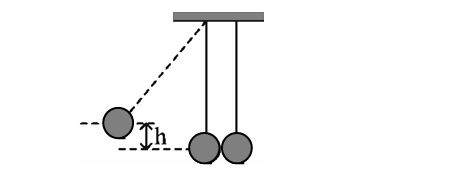
In the figure, pendulum bob on left side is pulled a side to a height h from its initial position. After it is released it collides with the right pendulum bob at rest, which is of same mass. After the collision, the two bobs stick together and rise to a height.