PHYSICS BYTES
Rank Booster Test Series - 05
TOPIC : Oscillation, Waves, Experimental Skills - Simple pendulum, Resonance tube
BEWARE OF NEGATIVE MARKING
1.
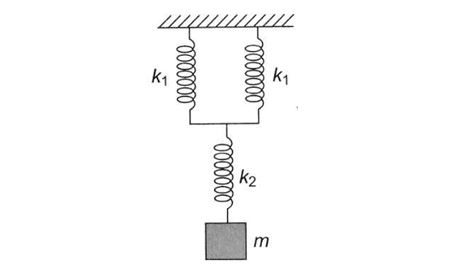
What will be the force constant of the spring system shown in the figure:
2.
In the given progressive wave equation $y=0.5~\sin(10\pi t-5x)$ where x, y in cm and t in second. The maximum velocity of the particle is:
3.
The equation of motion of a particle executing simple harmonic motion is $a+16\pi^{2}x=0$. In this equation a is the linear acceleration in $m/s^{2}$ of the particle at a displacement x in meter. The time period in simple harmonic motion is:
4.
Which one of the following quantities is maximum when an object in simple harmonic motion is at its maximum displacement?
5.
A particle of mass 10gm is placed in a potential field given by $V=(50x^{2}+100)J/kg$. The frequency of oscillation in cycle/sec is:
6.
A body is executing SHM under the action of a force whose maximum magnitude is 50N. The magnitude of force acting on the particle at the time when its energy is half kinetic and half-potential is (assume potential energy to be zero at mean position):
7.
A particle of mass m is executing SHM about the origin on x-axis with frequency $\sqrt{\frac{ka}{\pi m}}$ where k is a constant and a is the amplitude. Find its potential energy, if x is the displacement at time t:
8.
Sound wave of frequency $=600Hz$ fall normally on a perfectly reflecting wall. The shortest distance from the wall at which all particles will have maximum amplitude of vibration will be (speed of sound $=300~m/s$):
9.
Energy is constantly fed to a spring oscillator of force constant $225 \pi^{2}Nm^{-1}$ and attached mass 0.01 kg at a frequency of 50 cycles per sec. Will the resonance be achieved?
10.
Two pendulums have time period T and $\frac{5T}{4}$. They start swinging in S.H.M. together. What will be the phase difference between them after the longer has completed one oscillation?
11.
Two particles P and Q start from the origin and executes S.H.M. along x-axis with same amplitudes but with period 3 sec. and 6 sec. The ratio of the velocities of P and Q when they meet is:
12.
A simple harmonic oscillator has a period T and energy E. The amplitude of the oscillator is double. Choose the correct answer:
13.
A lift is ascending with an acceleration equal to $g/3$. What will be the time period of the simple pendulum suspended from its ceiling if its time period in stationary lift is T?
14.
A body is executing S.H.M. At a displacement x its P.E. is $E_{1}$ and at a displacement y its P.E. is $E_{2}$. The P.E. E at a displacement (x+y) is:
15.
A particle at the end of a spring executes S.H.M. with a period $t_{1}$ while the corresponding period for another spring is $t_{2}$. If the period of oscillation with the two springs in series is T, then
16.
If a cylinder of mass m, length L, density of material p and uniform area of cross section A, oscillates vertically in a liquid of density $\sigma$, then the time period of oscillation is given by:
17.
A string of mass 2.5 kg is under tension of 200 N. The length of the stretched string is 20.0 m. If the transverse jerk is struck at one end of the string, the disturbance will reach the other end in:
18.
A closed organ pipe (closed at one end) is excited to support the third overtone. It is found that air in the pipe has
19.
A tuning fork with frequency 800 Hz produces resonance in a resonance column tube with upper end open and lower end closed by water surface. Successive resonance are observed at length 9.75 cm, 31.25 cm and 52.75 cm. The speed of sound in air is:
20.
A tuning fork is used to produce resonance in a glass tube. The length of the air column in this tube can be adjusted by a variable piston. At room temperature of $27^{\circ}C$ two successive resonances are produced at 20 cm and 73 cm of column length. If the frequency of the tuning fork is 320 Hz, end correction in tube is
21.
An air column, closed at one end and open at the other, resonates with a tuning fork when the smallest length of the column is 50 cm. The next larger length of the column resonating with the same tuning fork is:
22.
A man sets his watch by a whistle that is 2 km away. How much will his watch be in error. (speed of sound in air $330~m/sec$)
23.
A wave travelling on a string is described by $y(x,t)=0.005~\sin(80.0x-3.0t)$. The period of the wave is
24.
A spherical source of power 4 W and frequency 800 Hz is emitting sound waves. The intensity of waves at a distance 200 m is:
25.
Quality of a musical note depends on
26.
A sound wave is represented by pressure wave as well as displacement wave. The phase difference between these two waves is:
27.
Two sound waves of amplitude A and 2A of same frequency are moving in same direction and interfere. The ratio of $\frac{I_{max}-I_{min}}{I_{max}+I_{min}}$ is:
28.
In a plane progressive harmonic wave particle speed is always less than the wave speed if
29.
A tuning fork of known frequency 256 Hz makes $5~beat/s$ with the vibrating string of a piano. The beat frequency increases to $7~beat/s$ when the tension in the piano string is slightly increased. The frequency of the piano string before increasing the tension was
30.
The equation of stationary wave along a stretched string given by $y=5~\sin(\frac{\pi x}{3})\cos(40\pi t)$ where x and y are in cm and t in second. The separation between two adjacent nodes is
31.
A glass tube 1.0 m length is filled with water. The water can be drained out slowly at the bottom of the tube. If a vibrating tuning fork of frequency 500 c/s is brought at the upper end of the tube and the velocity of sound is $330~m/s$, then the total number of resonances obtained will be
32.
Two travelling waves $y_{1}=A~\sin[k(x-ct)]$ and $y_{2}=A~\sin[k(x+ct)]$ are superimposed on string. The distance between adjacent nodes is
33.
Three simple harmonic motions of equal amplitudes A and equal time periods in the same direction combine. The phase of the second motion is $60^{\circ}$ ahead of the first and the phase of the third motion is $60^{\circ}$ ahead of the second. Find the amplitude of the resultant motion.
34.
Given below are some functions of x and t to represent the displacement of an elastic wave. Which represent a stationary wave?
35.
In a sinusoidal wave, the time required for a particular point to move from maximum displacement to zero displacement is 0.170 second. The frequency of the wave is:
36.
Which one of the following does not represent a travelling wave?
37.
Statement-1: In the case of a stationary wave, a person hear a loud sound at the nodes as compared to the antinodes.
Statement-2: In a stationary wave all the particles of the medium vibrate in phase.
Statement-2: In a stationary wave all the particles of the medium vibrate in phase.
38.
You are given four tuning forks, the lowest frequency of the fork is 300 Hz. By striking two tuning forks at a time any of 1, 2, 3, 5, 7 and 8 Hz beat frequencies are heard. The possible frequencies of the other three forks -
(A) 301, 302 and 307
(B) 301, 303 and 308
(C) 300, 304 and 307
(D) 305, 307 and 308
(A) 301, 302 and 307
(B) 301, 303 and 308
(C) 300, 304 and 307
(D) 305, 307 and 308
39.
The amplitude of a particle executing SHM is 4 cm. At the mean position the speed of the particle is $16~cm/sec$. The distance of the particle from the mean position at which the speed of the particle becomes $8\sqrt{3}$ cm/s, will be
40.
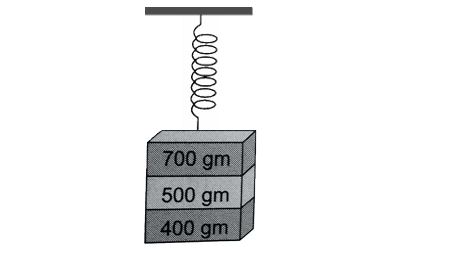
Three masses 700 g, 500 g and 400 g are suspended at the end of a spring as shown and are in equilibrium. When the 700 g mass is removed, the system oscillates with a period of 3 seconds, when the 500 gm mass is also removed, it will oscillate with a period of
41.
The time period of a second's pendulum is 2 sec. The spherical bob which is empty from inside has a mass of 50 gm. This is now replaced by another solid bob of same radius but having different mass of 100 gm. The new time period will be
42.
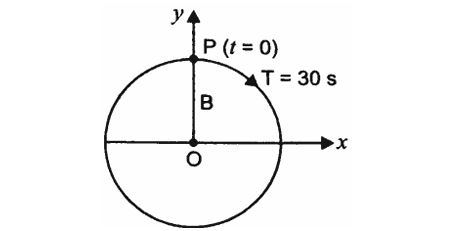
Figure shows the circular motion of a particle. The radius of the circle, the period, sense of revolution and the initial position are indicated on the figure. The simple harmonic motion of the x-projection of the radius vector of the rotating particle P is
43.
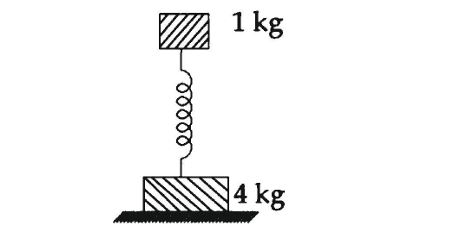
Two bodies of masses 1 kg and 4 kg are connected to a vertical spring, as shown in the figure. The smaller mass executes simple harmonic motion of angular frequency $25~rad/s$, and amplitude 1.6 cm while the bigger mass remains stationary on the ground. The maximum force exerted by the system on the floor is (take $g=10~ms^{-2}$)
44.
If c is r.m.s. speed of molecules in a gas and v is the speed of sound waves in the gas. then the ratio of c/v:
45.
The total length of a sonometer wire between fixed ends is 110 cm. Two bridges are placed to divide the length of wire in ratio 6:3:2. The tension in the wire is 400 N and the mass per unit length is $0.01~kg/m$. What is the minimum common frequency with which three parts can vibrate?