PHYSICS BYTES
Rank Booster Test Series - 08
TOPIC : Electric Charges and Fields, Electrostatic Potential and Capacitance
BEWARE OF NEGATIVE MARKING
1.
A soap bubble is given a negative charge, then its radius:
2.
The value of electric permittivity of free space is:
3.
The charge q is placed in a uniform electric field E, work done by electric field when it moves a distance Y is:
4.
Three concentric metallic spherical shells of radii R, 2R, 3R, are given charges $Q_{1}$, $Q_{2}$, $Q_{3}$ respectively. It is found that the surface charge densities on the outer surfaces of the shells are equal. Then, the ratio of the charges given to the shells, $Q_{1}:Q_{2}:Q_{3}$, is
5.
If a charge q is placed at the centre of the line joining two equal charges Q such that the system is in equilibrium then the value of q is:
6.
The electric field intensity just sufficient to balance the earth's gravitational attraction on an electron will be (given mass and charge of an electron respectively are $9.1\times10^{-31}$ kg and $1.6\times10^{-19}C$)
7.
A polythene piece rubbed with wool is found to have a negative charge of $3\times10^{-7}C$. Estimate the number of electrons transferred
8.
An electric dipole consisting of two opposite charges of $2\times10^{-6}C$ each separated by a distance of 3 cm is placed in an electric field of $2\times10^{5}N/C$. The maximum torque on the dipole will be :
9.
Electric field strength due to a point charge of 5 $\mu$C at a distance of 80 cm from the charge is :
10.
A charged ball B hangs from a silk thread S, which makes an angle $\theta$ with a large charged conducting sheet P, as shown in the figure. The surface charge density $\sigma$ of the sheet is proportional to

11.
Which of the following can not be dielectric constant of a medium:
12.
Two charged spheres of radii 10 cm and 15 cm are connected by a thin wire. No current will flow, if they have
13.
Three charges 2q, -q, -q are located at the vertices of an equilateral triangle. At the centre of the triangle
14.
If a charged spherical conductor of radius 10 cm has potential V at a point distant 5 cm from its centre, then the potential at a point distant 15 cm from the centre will be
15.
Two unlike charges of magnitude q are separated by a distance 2d. The potential at a point midway between them is :
16.
When a proton is accelerated through 1V, then its kinetic energy will be :
17.
Work done in moving a positive charge on an equipotential surface is :
18.
When a positive q charge is taken from lower potential to a higher potential point, then its potential energy will:
19.
Eight drops of mercury of equal radii possessing equal charges combine to form a big drop. Then the capacitance of bigger drop compared to each individual small drop is:
20.
The potential gradient at which the dielectric of a condenser just gets punctured is called
21.
A parallel plate capacitor is first charged and then a dielectric slab is introduced between the plates. The quantity that remains unchanged is (battery is disconnected after charging):
22.
The capacity of a parallel plate condenser is 10µF without dielectric. Dielectric of constant 2 is used to fill half the distance between the plates, the new capacitance in µF is :
23.
Two conducting spheres of radii 5 cm and 10 cm are given a charge of 15µC each. After the two spheres are joined by a conducting wire, the charge on the smaller sphere is :
24.
A parallel plate capacitor has plate area A and separation d. It is charged to a potential difference $V_{0}$. The charging battery is disconnected and the plates are pulled apart to three times the initial separation. The work required to separate the plates is:
25.
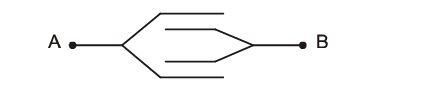
Four plates of equal area A are separated by equal distances d and are arranged as shown in the figure. The equivalent capacity is:
26.
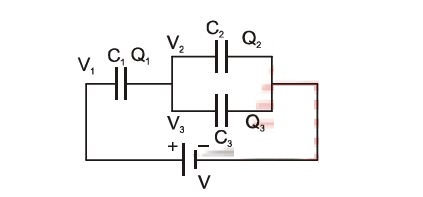
In an adjoining figure are shown three capacitors $C_{1}, C_{2}$ and $C_{3}$ joined to a battery. The correct condition will be (Symbols have their usual meanings)
27.
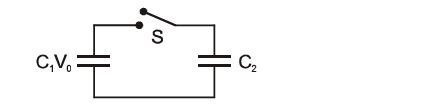
A capacitor of capacity $C_{1}$ is charged to the potential of $V_{0}$. On disconnecting with the battery, it is connected with a capacitor of capacity $C_{2}$ as shown in the adjoining figure. The ratio of energies before and after the connection of switch S will be:
28.
A parallel plate condenser is filled with two dielectrics as shown. Area of each plate is A metre² and the separation is t metre. The dielectric constants are $k_{1}$ and $k_{2}$ respectively. Its capacitance in farad will be :

29.
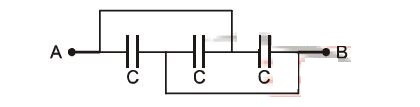
Three equal capacitors, each with capacitance C are connected as shown in figure. Then the equivalent capacitance between A and B is:
30.
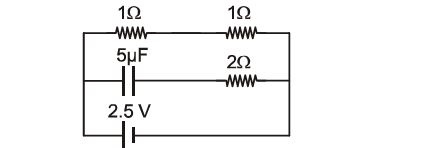
A capacitor of 5µF is charged by a battery of 2.5 V as shown in figure. When the switch is closed, what is the charge flowing out of the battery?
31.
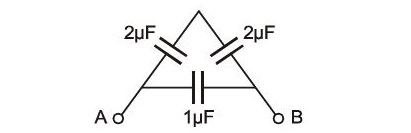
What is the effective capacitance between A and B in the following figure :
32.
Potential energy of a system comprising of point charges is $U_{1}$. When a charge q is added in the system without disturbing other charges, the potential energy becomes $U_{2}$. The potential of the point where the charge q is placed in the system is:
33.
Two charges -2µc and 8µc are kept at A (1m, 2m, 1m) and B(2m, 1m, 0) respectively. The force experienced by the 2µc charge is:
34.
A capacitor has plates of area $50~cm^{2}$ separated by 2 mm air. What is the maximum emf of a battery that can be connected to the capacitor plates and corresponding charge on the plates if the dielectric strength of air is $3\times10^{6}V/m$?
35.
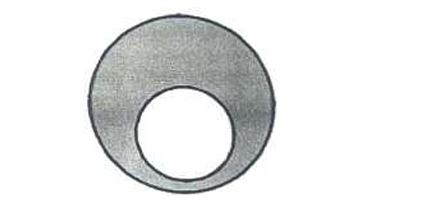
A spherical portion has been removed from a solid sphere having a charge distributed uniformly in its volume as shown in the figure. The electric field inside the emptied space is:
36.
Electric field at a distance x from origin is given as $E=\frac{100}{x^{2}}$, then potential difference between points situated at $x=10$ m and 20 m.
37.
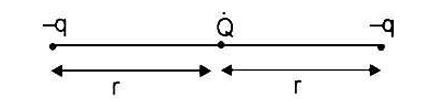
Three charges -q, Q and -q are placed as shown in figure, if the electric potential energy of system is zero, then Q:q
38.
Consider the following statements about an electric dipole and select the correct ones:
$S_{1}$: Electric dipole moment vector $\vec{p}$ is directed from the negative charge to the positive charge.
$S_{2}$: The electric field of a dipole at a point with position vector $\vec{r}$ depends on $|\vec{r}|$ as well as the angle between $\vec{r}$ and $\vec{p}$.
$S_{3}$: The electric dipole potential falls off as $1/r^{2}$ and not as $1/r$.
$S_{4}$: In a uniform electric field, the electric dipole experiences no net force but a torque $\vec{\tau}=\vec{p}\times\vec{E}$.
$S_{1}$: Electric dipole moment vector $\vec{p}$ is directed from the negative charge to the positive charge.
$S_{2}$: The electric field of a dipole at a point with position vector $\vec{r}$ depends on $|\vec{r}|$ as well as the angle between $\vec{r}$ and $\vec{p}$.
$S_{3}$: The electric dipole potential falls off as $1/r^{2}$ and not as $1/r$.
$S_{4}$: In a uniform electric field, the electric dipole experiences no net force but a torque $\vec{\tau}=\vec{p}\times\vec{E}$.
39.
A plane charged conducting surface carries a uniform surface charge density $\sigma$. If $\vec{E}_{1}$ and $\vec{E}_{2}$ are the electric fields just inside and just outside the surface respectively, and $\hat{n}$ is the unit normal drawn from inside to outside, which of the following is correct?
40.
At the surface of a charged conductor, the electric field is discontinuous. Which of the following statements about electric potential is correct?
41.
A parallel plate capacitor is to be designed for a voltage rating of 1 kV using a dielectric of Dielectric constant $k=3$ Dielectric strength $=10^{7}Vm^{-1}$. For safety, the electric field should not exceed 10% of the dielectric strength. If the required capacitance is 50 pF, what is the minimum area of the plates?
42.
A tiny hole is made on the surface of a hollow charged conductor. If the surface charge density near the hole is $\sigma$, the electric field inside the hole is:
43.
In a region, the electric field is given by: $\vec{E}=(2x\hat{i}+2y\hat{j})$. If the electric potential at the origin is $V(0,0)$, what is the electric potential $V(x,y)$ at any point (x, y)?
44.
Match the columns:
Column-I
A. Electric field due to infinite line charge
B. Electric field just outside a charged conductor
C. Electric field inside a tiny hole on conductor
D. Electric field due to infinite charged sheet
Column-II
1. $\frac{\lambda}{2\pi\epsilon_{0}r}$
2. $\frac{\sigma}{\epsilon_{0}}$
3. $\frac{\sigma}{2\epsilon_{0}}$
Column-I
A. Electric field due to infinite line charge
B. Electric field just outside a charged conductor
C. Electric field inside a tiny hole on conductor
D. Electric field due to infinite charged sheet
Column-II
1. $\frac{\lambda}{2\pi\epsilon_{0}r}$
2. $\frac{\sigma}{\epsilon_{0}}$
3. $\frac{\sigma}{2\epsilon_{0}}$
45.
A charge q moves from point A to B under the influence of electrostatic force only. If the electric potentials at A and B are $V_{A}$ and $V_{B}$ respectively, then the work done by the electrostatic force is: