PHYSICS BYTES
Rank Booster Test Series - 11
TOPIC : Ray Optics and Optical Instruments, Wave Optics
BEWARE OF NEGATIVE MARKING
1.
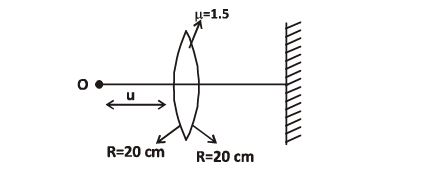
If a biconvex lens of refractive index $\mu=1.5$ is shown in fig. At what distance from convex lens point object O should be placed so that image is formed at object itself:
2.
A double convex lens of focal length 6 cm is made of glass of refractive index 1.5. The radius of curvature of one surface is double that of the other surface. The value of smaller radius of curvature is:
3.
The focal length of an equiconvex lens in air is equal to either of its radii of curvature. The refractive index of the material of the lens is:
4.
A convex lens forms a real image of an object for its two different positions on a screen. If the heights of the images in two cases be 8 cm and 2 cm, then the height of the object is:
5.
A thin lens of focal length f and its aperture has a diameter d. It forms an image of intensity I. Now the central part of the aperture upto diameter $d/2$ is blocked by an opaque paper. The focal length and image intensity would change to:
6.
A concave lens with unequal radii of curvature made of glass $(\mu_{g}=1.5)$ has a focal length of 40 cm. In air if it is immersed in a liquid of refractive index $\mu_{1}=2,$ then :
7.
An equiconvex lens of glass $(\mu_{g}=1.5)$ of focal length 10 cm is silvered on one side. It will behave like a:
8.
Light of wavelength 5000 Å falls on a plane reflecting surface. For what angle of incidence is the reflected ray normal to the incident ray :
9.
A cut diamond sparkles because of the :
10.
Time taken by light to cross a 4 mm thick glass slab of refractive index 3 is:
11.
The principle behind optical fibres is:
12.
The transverse nature of light is shown by:
13.
Two transparent media A and B are in contact. Velocity of light in A is $2\times10^{8}ms^{-1}$ and in B is $2.5\times10^{8}ms^{-1}.$ The critical angle for which ray of light going from A to B is totally internally reflected is:
14.
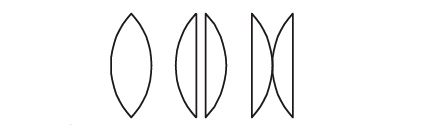
A convex lens of focal length 20 cm is cut into two equal part so as to obtain two plano-convex lenses as shown in figure. The two parts are then put in contact as shown in figure. What is the focal length of the combination:
15.
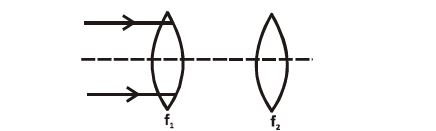
A parallel beam of light is incident on a system of two convex lenses of focal lengths $f_{1}=20$ cm and $f_{2}=10$ cm, what should be the distance between the two lenses so that rays after refraction from both the lenses pass undeviated:
16.
The optical axis of a thin equiconvex lens is the x-axis. The co-ordinates of a point object and its image are (-40 cm, 1 cm) and (50 cm, -2 cm) respectively. The lens is located at:
17.
An astronomical telescope of six-fold angular magnification has a length of 42 cm. The focal length of the objective is:
18.
A beam of light of wavelength 600 nm from a distant source falls on a single slit 1.00 mm wide and the resulting diffraction pattern is observed on a screen 2 m away. Calculate the distance between the first dark fringes on either side of the central bright fringe:
19.
In placing a thin sheet of mica of thickness $12\times10^{-5}$ cm in the path of the interfearing beams in YDSE. The central frings shift equal to frings width. Refractive index of mica $(\lambda=600~nm)$ :
20.
Wavefront means :
21.
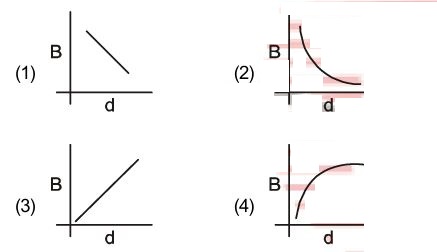
The correct curve between fringe width $\beta$ and distance between the slit d is:
22.
Two light rays having the samewavelength is vaccum are in phase initially. Then the first ray trevells a path $L_{1}$ through a medium of refractive index $n_{1}$ while second ray travells a path of length $L_{2}$ through a medium of refractive index $n_{2}$. The two waves then combined to produce interfeance. The phase difference between the two waves:
23.
Two cohrent sources of intensity ratio $\beta$ interfere. Then the value of $\frac{(I_{max}-I_{min})}{I_{max}+I_{min}}$ is:
24.
In a young double slit experiment. The fringe width found to be 0.4 mm. Now whole apparatus is dipped in water of refractive index $4/3$ without disturbing the arrangement. The new fringe width will be:
25.
A plane wavefront is incident at an angle of 37° with horizontal a boundry of refractive medium from air $\mu=1$ to a medium of refractive index $\mu=\frac{3}{2}$. Find the angle of reflected wavefront with horizontal:
26.
Two cohrent sources each emitting light of their intensity $I_{0}$ interfere in a medium at a point where phase difference between them is $\frac{2\pi}{3}$. The resultant intensity at that point would be:
27.
The path difference produced by two waves is $3.75~\mu m$ and wavelength is 5000Å. The point is:
28.
A beam of electron is used in an YDSE experiment. The slit width is d. When the velocity of electron is increased, then :
29.
Which one of the following phenomena is not explained by Huygen's construction of wavefront?
30.
Ratio of intensities of two waves are given by 4: 1. Then ratio of the amplitudes of the two waves is
31.
Interference is possible in
32.
In Young's double slit experiment, the slits are 2 mm apart and are illuminated by photons of two wavelengths $\lambda_{1}=12000$ Å and $\lambda_{2}=10000$ Å At what minimum distance from the common central bright fringe on the screen 2 m from the slit will a bright fringe from one interference pattern coincide with a bright fringe from the other?
33.
Interference was observed in interference chamber where air was present, now the chamber is evacuated, and if the same light is used, a careful observer will see
34.
In a diffraction pattern due to a single slit of width 'a', the first minimum is observed at an angle $30^{\circ}$ when light of wavelength 5000 Å is incident on the slit. The first secondary maximum is observed at an angle of:
35.
Diffraction fringes are of:
36.
Two wavelength of light $\lambda_{1}$ and $\lambda_{2}$ are sent through Young's double slit apparatus simultaneously. What must be true concerning $\lambda_{1}$ and $\lambda_{2}$ if the third order $\lambda_{1}$ bright fringe is to coincide with the fourth order $\lambda_{2}$ bright fringe?
37.
A Young's double slit experiment uses a monochromatic source. The shape of the interference fringes fromed on a screen:
38.
A concave spherical mirror produces an inverted image of an object. The distance between the object and the image is d, and the magnification is M. The focal length f of the mirror is given by:
39.
Light is incident from a medium A to medium B. The graph between sin i (x-axis) and sin r (y-axis) is shown. Which of the following statements is/are correct?
(i) Total internal reflection occurs above a certain value of i.
(ii) Total internal reflection will not occur for any value of i.
(iii) Wavelength of light in medium B is $\sqrt{3}$ times that in medium A.
(iv) Wavelength of light in medium B is $1/\sqrt{3}$ times that in medium A.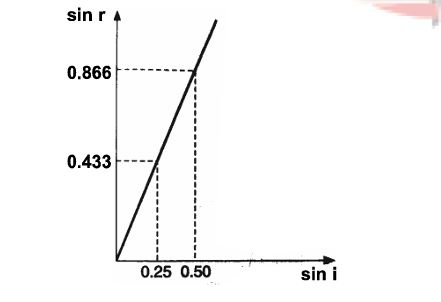
(i) Total internal reflection occurs above a certain value of i.
(ii) Total internal reflection will not occur for any value of i.
(iii) Wavelength of light in medium B is $\sqrt{3}$ times that in medium A.
(iv) Wavelength of light in medium B is $1/\sqrt{3}$ times that in medium A.
40.
A light ray is incident on one face of a parallel sided transparent slab of refractive index $\mu$ and thickness t. The angle of incidence is double the angle of refraction at the first surface. The lateral displacement of the ray is:
41.
A prism is made of a material having refractive index $\mu=\frac{\sqrt{6}}{2}$. A light ray is incident on the prism at an angle $\pi/3$ and suffers minimum deviation. Find the angle of the prism.
42.
When an unpolarised light wave is incident on a polaroid sheet, which of the following statements is/are correct?
(i) The electric field component parallel to the aligned molecules of the polaroid is absorbed.
(ii) The transmitted light becomes linearly polarised.
(iii) The direction perpendicular to the aligned molecules is called the pass-axis.
(iv) The intensity of transmitted light becomes zero.
(i) The electric field component parallel to the aligned molecules of the polaroid is absorbed.
(ii) The transmitted light becomes linearly polarised.
(iii) The direction perpendicular to the aligned molecules is called the pass-axis.
(iv) The intensity of transmitted light becomes zero.
43.
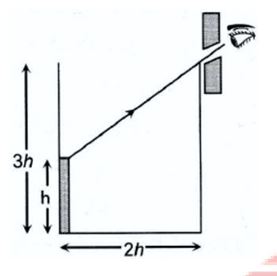
An observer can see through a pin hole, the top end of a thin rod of height h, placed as shown in the figure. The beaker's height is 3h and its radius h. When the beaker is filled with a liquid upto a height 2h, he can see the lower end of the rod. The refractive index of the liquid is:
44.
Cassegrain telescope has
45.
Which of the followiing is true.
(a) In optical fibre material, there should be very little absorption of light.
(b) In modern microscope, multicomponent lenses are used.
(c) Light travel faster in optically densed medium.
(a) In optical fibre material, there should be very little absorption of light.
(b) In modern microscope, multicomponent lenses are used.
(c) Light travel faster in optically densed medium.